Courtney Drysdale
Courtney Drysdale was a 30-year-old mother and small business owner who was brutally murdered on February 2, 2026, in rural Momence, Illinois. Drysdale was targeted inside her own establishment during an **execution-style armed robbery** perpetrated by a former coworker. The case sparked widespread outrage due to the senseless nature of the violence and the suspect's extensive violent criminal history.
Courtney Drysdale

Courtney Drysdale was a 30-year-old mother and local business owner.
Courtney M. Drysdale was a lifelong resident of the Momence area, known by friends and family as a kind, hard-working, and deeply dedicated individual. She was a mother to a young child and was engaged to be married to her fiancé, Neil Trudeau. Seeking to build a stable future for her family, Drysdale achieved her dream of entrepreneurship by taking over ownership of a local establishment on Illinois Route 114, renaming it The Line bar. Loved ones described her as a beautiful soul who welcomed everyone with warmth, making her a beloved fixture within the tight-knit community near the Illinois-Indiana state border.
Incident Description
On the morning of February 2, 2026, at approximately 11:00 a.m., Drysdale opened The Line bar for standard business hours. Security footage captured her alone inside the premises. Within five minutes of opening, a white BMW sedan with a sunroof pulled into the property's parking lot. The driver, later identified as Julius Burkes, exited the vehicle wearing a bright yellow-green reflective work jacket, a baseball cap with an underlying head covering, dark work gloves, and glasses.
Surveillance video from inside the establishment showed Burkes pulling a handgun from his right jacket pocket immediately upon entry. He pointed the weapon at Drysdale and ordered her around the counter, forcing her to comply with demands for money. Drysdale offered no resistance, cooperatively handing over cash from both the register and the back office. Despite her total compliance, Burkes ordered her to sit on the floor behind the bar. He then shot her once in the head execution-style. According to prosecutors, video evidence showed Burkes beginning to walk away before turning back around to shoot Drysdale a second time in the head.
Before fleeing the scene, Burkes attempted to tear down a digital recording device from the wall in an effort to destroy evidence of the crime. He then drove east across the state line back into Indiana.
Julius Burkes
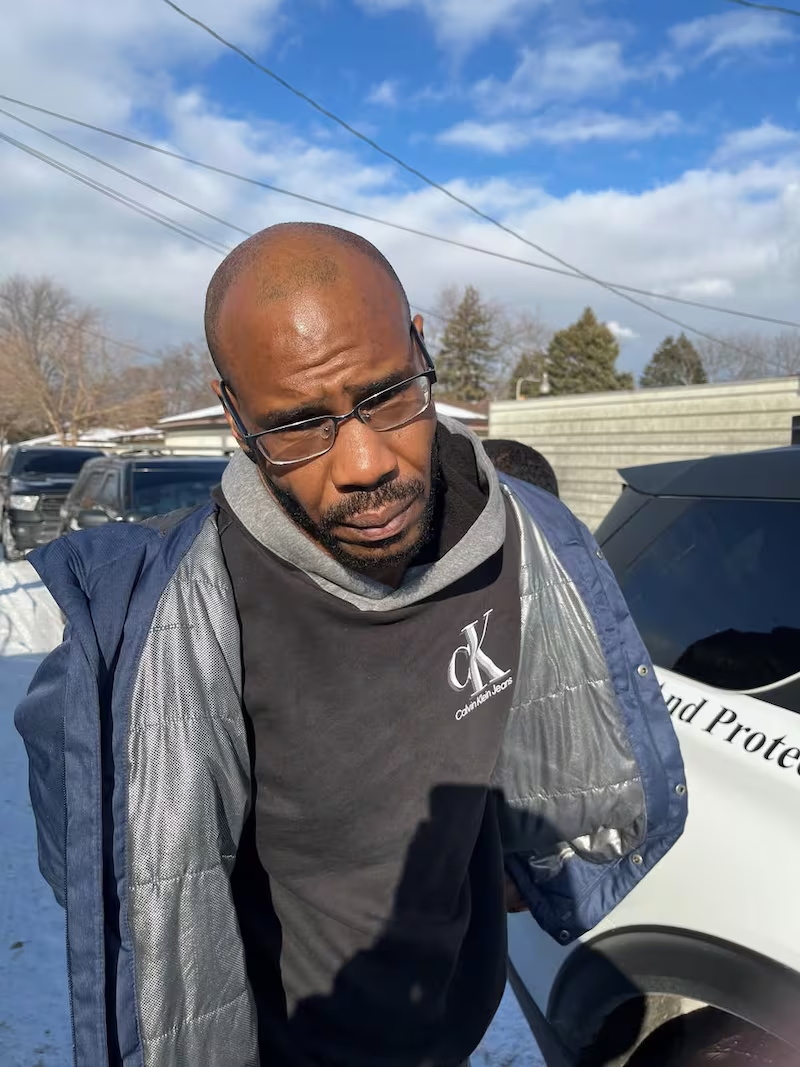
Julius Burkes, a convicted felon facing federal murder charges.
Julius E. Burkes, 47, of Hammond, Indiana, was arrested on February 3, 2026—just 26 hours after the homicide. Heavily armed officers, including Kankakee County Sheriff's deputies, Hammond police, and U.S. Marshals, apprehended Burkes as he attempted to leave his Indiana residence. Investigators quickly linked Burkes to the business; he had been employed at the establishment between 2017 and 2019 under its previous owner. During that period, Drysdale had discovered Burkes stealing money from the business and reported him, which directly resulted in his termination, establishing a clear motive of deep-seated resentment.
Burkes possessed a lengthy and violent history within the criminal justice system. In 1994, he was convicted of a double homicide in Cook County, Illinois, and received a 37-year prison sentence. Following his release, his interactions with law enforcement continued, including a 2014 conviction for battery, an order of protection filed against him in 2017, and a DUI conviction in 2022. Most notably, at the time of Drysdale's murder, Burkes was out on bond in Indiana following a December 2025 arrest for residential burglary in Crown Point.
Controversy
The murder of Courtney Drysdale ignited intense public outrage regarding systemic breakdowns within the Midwestern judicial framework. Critics pointed to the tragedy as a stark consequence of soft-on-crime policies and a revolving-door justice system that repeatedly prioritizes the freedom of habitual, violent offenders over public safety. Despite having a prior conviction for a double homicide and a subsequent record of battery, Burkes was granted bond and allowed back onto the streets following a felony residential burglary charge just two months prior to the murder. Public advocates argued that an individual with a proven history of taking human lives should never have been eligible for pre-trial release, noting that stricter detention standards would have kept a dangerous killer incapacitated and saved an innocent mother's life.
Additionally, the initial handling of the case under Illinois state law drew scrutiny regarding fast-tracked procedural rules. When Burkes requested a speedy trial, state prosecutors were forced into a restrictive 90-day window mandated by the state's controversial SAFE-T Act, down from the traditional 120 days. This accelerated timeline forced the prosecution to rush the gathering and distribution of complex digital discovery materials right up to the eve of trial, adding immense logistical pressure to an already strained local justice system.
Current Status
Following his arrest, Burkes waived extradition in Lake County, Indiana, and was transferred to the Kankakee County Jail, where he initially pleaded not guilty to three counts of first-degree murder, armed robbery, and being a felon in possession of a firearm. However, the trajectory of the prosecution shifted dramatically on April 16, 2026, when Kankakee County State's Attorney Jim Rowe announced that local charges were being dismissed so federal authorities could take over the case.
A federal grand jury indicted Burkes in the U.S. District Court for the Central District of Illinois on charges of obstruction of commerce by robbery, murder, and possession of a firearm and ammunition as a felon. The jurisdictional transfer allows prosecutors to pursue harsher federal penalties that are unavailable under current Illinois state statutes. Burkes remains detained without bail as federal prosecutors proceed with a case that carries a maximum penalty of life imprisonment without parole or the death penalty.